
|
 |
At night, I like to gaze at the stars in the sky. Far from the city and at the right time of the year, when your eyes get used to the darkness you see the core of the Milky Way appear majestically. The heavens are a phenomenon that has always intrigued mankind.
Allegedly, primeval people seem to have thought that all those distant lights were campfires from distant tribes. Early civilizations explained stars as holes in a vast spherical firmament, which supposedly shielded the Earth at its center from an outside eternal light. This idea is understandable, since stars do not appear to move relative to each other, and to the naked eye the starry sky appears to have no depth.
It is a perception that persisted until in the late eighteenth century William Herschel, after endlessly staring through a telescope, first proposed the spatial positions of many stars. What did he discover? Stars were not lying on a sphere, but rather floating within one! The realization dawned that all stars were part of a single structure, the Milky Way. Even a young Albert Einstein was taught that the Milky Way was the entire universe.
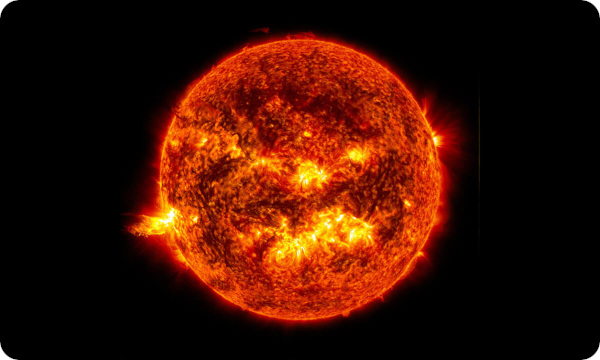
Distances between stars are unimaginably vast. For example, our Sun is an average star. Its nearest neighbours are Alpha Centauri A and B, two stars roughly the same size as the Sun, and of course red dwarf Proxima Centauri. If the Sun were a soccer ball, then the Earth would be a grain of sand about 25 meters away. Now if this miniature Sun were in Amsterdam, Alpha Centauri A and B would be two soccer balls somewhere in … Detroit. The Milky Way is not just unfathomably large, it is also incredibly empty.
Edwin Hubble discovered about a hundred years ago that several nebulae supposedly in the Milky Way, actually are other galaxies far beyond our own star system. In the decades that followed, the universe was found to be teeming with galaxies. Latest estimates are that there can be as many as two trillion of them. Our Milky Way, a typical galaxy, is estimated to consist of upto four hundred billion stars. In other words, for every grain of sand on Earth, there are perhaps tens of thousands of stars out there. Let that sink in for a moment.
Now you are probably wondering why, if there are that many stars, it is still dark at night? You see, Hubble's work shows that the universe is not static, but continuously stretching. The further away something is from us, the faster it moves away. The velocity of light however is constant everywhere. As a result, very distant light has to swim against a too strong current so to speak, and could never reach us. The distant parts of the cosmos are therefore forever invisible to us, and visible stars twinkle against a background as black as midnight.
© 2001-2026 J.M. van der Veer
jmvdveer@algol68genie.nl